

If you are building a new home, doing a knock down rebuild, or purchasing a house and land package, your loan works differently from a standard home purchase. Instead of the lender handing over the full amount at settlement, funds are released in stages as the build progresses. These staged releases are called drawdowns or progress payments.
Most first-time builders underestimate how much the drawdown process affects their build timeline, cash flow and relationship with their builder. A delayed drawdown can stall construction for weeks. A funding gap between what the builder invoices and what the lender pays can leave you covering the shortfall from savings you did not budget for.
This guide walks through exactly how each drawdown works, what triggers each payment, how interest builds during a build, and the problems that trip people up. If you want the broader product overview, see our construction loans hub.
What is a construction loan drawdown?
A drawdown is a partial release of funds from your approved construction loan, paid directly to your builder when a defined stage of the build is complete. The lender does not give you the money. It goes straight from the lender to the builder after the lender confirms the work has been done.
This structure exists to protect both you and the lender. If the builder abandoned the project halfway through and the lender had already released the full loan amount, everyone would be exposed. By paying in stages, the lender only advances money against work that actually exists. For you, it means you are not paying interest on $600,000 from day one when only a concrete slab is in the ground.
How a regular purchase works
- Full loan amount released at settlement in one payment
- Principal and interest repayments start immediately
- Interest charged on the entire loan from day one
- Property exists and has been valued before settlement
How a build works
- Funds released in five to six staged progress payments
- Interest-only repayments during the build (on drawn funds only)
- Interest cost grows with each drawdown stage
- Property does not exist yet, valued "as if complete"
- Lender inspects or arranges valuation at each stage
- Converts to principal and interest after build completion
The five standard construction drawdown stages
Most residential construction loans in Australia release funds across five stages, though some contracts use six. The exact percentages vary depending on your building contract, the builder's payment schedule and the state you are building in. What matters is that your building contract and your loan offer use the same stage names and the same percentages. If they don't align, you will have funding gaps at every stage.
| Stage | Typical % of contract | What is completed | Cumulative drawn |
|---|---|---|---|
| Deposit | ~5% | Contract signed, council approvals, preliminary works | ~5% |
| Slab / Base | ~10 to 15% | Site prep, excavation, plumbing rough-in, slab poured | ~15 to 20% |
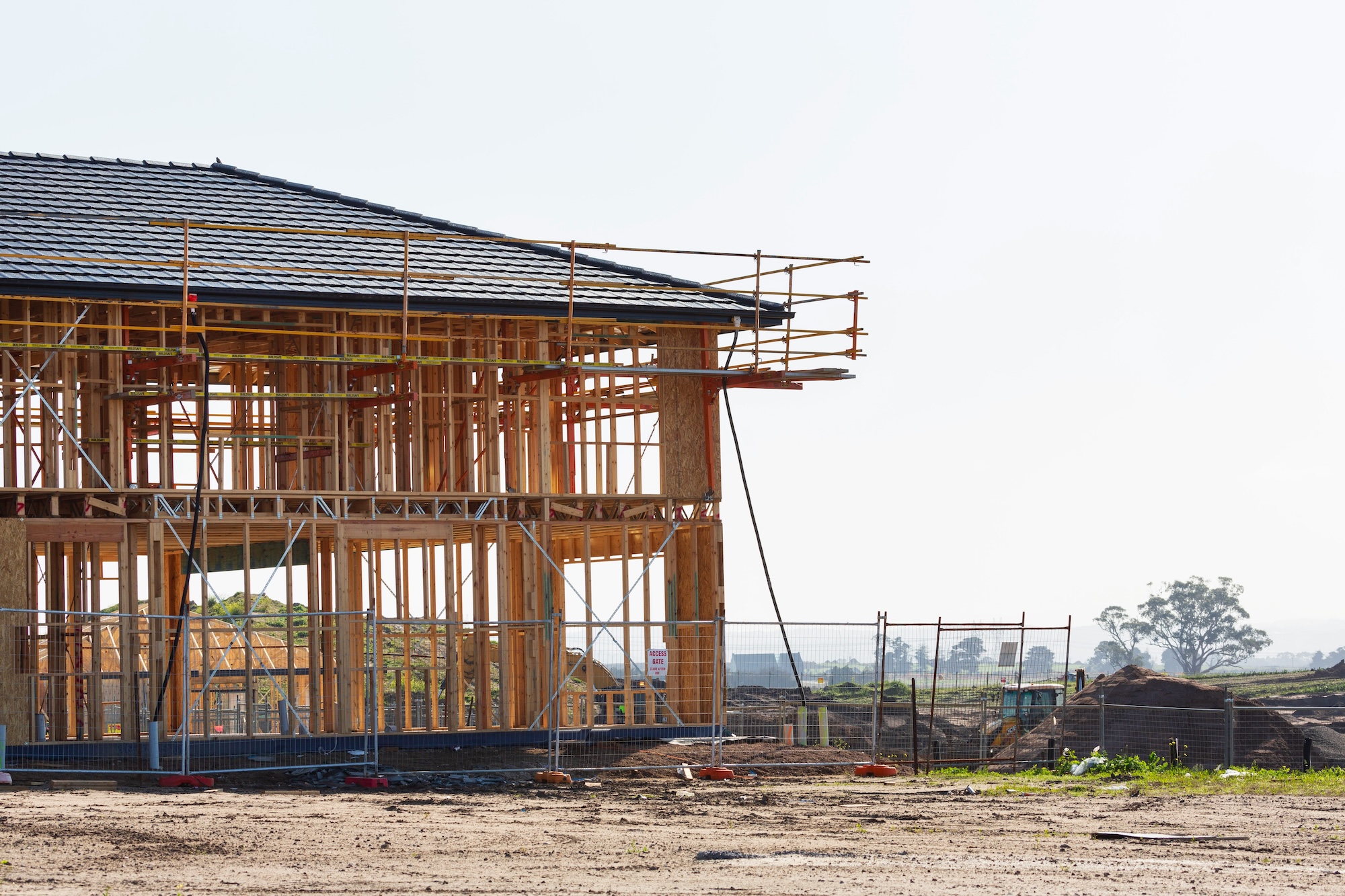
| Frame | ~15 to 20% | Wall frames, trusses, roof structure erected | ~35 to 40% |
| Lockup | ~20 to 25% | External cladding, windows, doors, roofing completed | ~55 to 65% |
| Fitout / Fixing | ~25 to 30% | Cabinetry, plumbing, electrical, tiling, plastering | ~85 to 95% |
| Completion | ~5 to 10% | Final detailing, fencing, landscaping, occupancy cert | 100% |
How each drawdown is released
The drawdown process follows the same pattern at every stage. Understanding this sequence helps you plan your cash flow and manage your builder's expectations about when they will actually get paid.
The drawdown release process
At each stage, the builder completes the work, then submits a progress claim to the lender. The lender arranges an inspection or sends a quantity surveyor (QS) to verify the work matches the approved plans. Once the inspection report is satisfactory, the lender processes the drawdown and pays the builder directly. You do not handle the money.
From the builder lodging their progress claim to funds landing in the builder's account, the process typically takes three to 14 business days. During busy building periods (especially summer), it can stretch longer. That means the builder is funding their own labour and materials during the gap. Builders with limited cash reserves can stall mid-stage waiting for payment, which pushes out your build timeline.
What the lender's inspector checks
The inspector or QS confirms that the work completed matches the approved building plans and specifications. They verify that the stage milestones defined in the loan offer have been met. If the inspector finds that the work falls short of the claimed stage, the lender will not release the full amount the builder invoiced. The lender pays based on what the inspector confirms, not what the builder claims.
Each progress inspection typically costs $200 to $500, charged to you. Across five to six stages, that adds $1,000 to $3,000 to your construction budget. Some lenders only inspect at the first and final stages for standard builds under $1 million, but this varies.
The builder sends an invoice or progress claim certificate to the lender, stating the stage is complete and requesting payment for the contracted amount.
The lender sends an inspector, valuer or quantity surveyor to the building site. They confirm the work matches the approved plans and the claimed stage is genuinely complete.
Some lenders require you to sign off on the builder's invoice before releasing funds. Check the work yourself before approving. Once the money is released, it is much harder to dispute.
After a satisfactory inspection and your approval, the lender releases the funds directly to the builder. Processing takes three to seven business days from inspection sign-off.

How interest works during construction
During the build, you make interest-only repayments on the amount drawn down so far, not the total approved loan. This means your monthly repayments start small and grow with each drawdown. Builders and borrowers sometimes call this "interest creep" because the cost builds gradually in a way that catches people off guard if they have not modelled it.
The following is a general reference example only. Actual figures vary by lender, interest rate, build cost, drawdown schedule and individual circumstances.
A few things to note about interest during construction. If you are also paying rent while you build, or if you already own land and are paying interest on the land loan separately, the total monthly outgoing can be significant by the lockup stage. Most builds take nine to 18 months, and delays (weather, materials, council approvals) extend that timeline and the total interest cost with it.
After the build reaches practical completion, the loan converts to standard principal and interest repayments on the full amount. Construction loan interest rates are typically 0.10% to 0.30% above equivalent standard variable home loan rates, reflecting the additional risk and administration the lender carries during the build.
Common construction drawdown problems
Most drawdown problems are avoidable. They usually come down to misalignment between the building contract and the loan, or assumptions about how quickly the lender will release funds.
Builder's invoice exceeds lender's valuation
The builder invoices for a stage, but the lender's inspector values the completed work at a lower amount. The gap has to come from your pocket. This happens when the building contract payment schedule and the loan drawdown schedule use different percentages or stage definitions.
Align the builder's payment schedule with the lender's drawdown stages before signing either document.
Drawdown delays stalling the build
Each drawdown can take two to three weeks from the builder's claim to funds arriving. Builders funding their own labour and materials during that lag can stall if their cash reserves run thin. The build stops until the money comes through.
Confirm the builder's capacity to absorb the lag. Ask for a cash flow letter before the build starts.
Mid-build variations creating unfunded gaps
A $40,000 kitchen upgrade or $20,000 landscaping addition mid-build becomes an unfunded cost because the loan was sized to the original contract. Most lenders won't increase the construction facility mid-build. You cover the extra from savings.
Include all likely variations in the original contract and loan application. Budget separately for anything you might add later.
Soil conditions pushing costs beyond the loan
Reactive clay or difficult soil can add $25,000 to $60,000 to footing costs above the original contract price. If the loan was sized on a standard footing allowance rather than a soil-tested quote, the gap is yours to fund.
Get a soil report and engineer's footing design before finalising the building contract and loan amount.
Underestimating total interest cost
Monthly interest starts small but compounds with each drawdown. On a $500,000 build over 12 months, total construction-period interest can exceed $20,000. If you are also paying rent, the combined monthly outgoing by lockup stage can be a real strain.
Model your interest at each stage before the build starts. Include rent or existing mortgage payments in the calculation.
Not having builder's insurance confirmed
Lenders require the builder to hold current domestic building insurance (sometimes called home warranty insurance) and construction insurance before releasing any drawdown. If these lapse or were never properly arranged, the drawdown stops.
Verify builder registration, domestic building insurance and construction insurance before the first drawdown.
Documents and conditions for each drawdown
Before the lender releases the very first drawdown, a set of conditions must be met. Missing any of these can delay your build start by weeks. After that, each subsequent drawdown has its own smaller set of requirements.
Before the first drawdown
Lenders will not release any construction funds until specific conditions are satisfied. Get these sorted well before your builder plans to start on site.
At each subsequent stage
For each drawdown after the first, the process is more straightforward but still has conditions.
When should you get construction finance help?
In short: before you sign the building contract. The drawdown structure, stage alignment, insurance requirements and interest modelling all need to be confirmed before you commit. Getting construction finance help makes particular sense if any of these apply:
A construction finance specialist can align your building contract with the lender's drawdown structure, model your interest at each stage, confirm insurance and documentation requirements, and help you avoid the funding gaps that stall builds and create disputes with builders.